

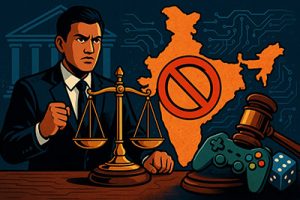
 India’s on-line gaming business, as soon as a quickly increasing market fueled by billions in international funding, is now dealing with unprecedented disruption after the implementation of the Promotion and Regulation of On-line Gaming Act, 2025. The sweeping laws, handed by Parliament and signed by President Droupadi Murmu, imposes a blanket ban on all money-based on-line video games, sparking the sector’s first authorized battle led by A23.
A23’s Petition Towards the Ban
A23, a number one operator in India recognized for its on-line rummy and poker choices, has filed a petition with the Karnataka Excessive Courtroom. The case, lodged by its mother or father firm, Head Digital Works, on August 28, challenges the legislation’s broad software. In its submitting, A23 argued that the laws “criminalises the legit enterprise of enjoying on-line video games of ability, which might consequence within the closure of varied gaming firms in a single day.” The corporate additional criticized the legislation as a “product of state paternalism,” urging the courtroom to deem it unconstitutional for skill-based platforms.
A23, which claims a person base exceeding 70 million registered gamers, is looking for judicial reduction to safeguard its operations and people of different related operators. As of now, the Ministry of Electronics and Data Know-how has not commented on the continued authorized proceedings.
The ban has already had a big impression available on the market. Platforms similar to Dream11, Cell Premier League (MPL), My11Circle, WinZO, Zupee, and PokerBaazi have both suspended or utterly shut down their money-based video games.
Fast Fallout Throughout the Trade
The abrupt enforcement of the Act despatched shockwaves all through the $3.7 billion gaming business, which was projected to develop to $9.1 billion by 2029, based on the India Gaming Report 2025. International traders, together with Tiger International and Peak XV Companions, have invested near $3 billion within the sector over the previous 5 years, underscoring India’s emergence as one of many largest gaming markets worldwide.
Dream11, a significant fantasy sports activities platform, has been significantly hard-hit. CEO Harsh Jain advised CNBC TV18, “95% of our group’s revenues have disappeared in a single day,” however added that the corporate has no plans to contest the brand new legislation. Equally, MPL introduced it could not pursue authorized motion, as an alternative pivoting its enterprise technique towards free-to-play fashions to stay operational.
Gameskraft, one other notable participant within the real-money gaming house, echoed this sentiment. In a press release, the corporate emphasised its compliance with the laws: “As a accountable and law-abiding company entity, Gameskraft has no intention of pursuing any authorized problem to the laws. We totally respect the legislative course of and stay dedicated to working throughout the framework of the legislation.”
The corporate additionally confirmed that it has paused ‘Add Money’ and gameplay companies on its well-liked rummy apps, together with RummyCulture, whereas initiating inner discussions on future technique. Regardless of the monetary blow, Dream11 has clarified that no layoffs are at the moment deliberate.
Divided Views on the Ban
The net gaming sector’s response to the Act is deeply divided. Proponents argue the ban is a essential step towards addressing the rise in playing habit, fraud, and cash laundering related to money-based on-line video games. Critics, nevertheless, say the laws is overly broad and dangers stifling innovation whereas jeopardizing 1000’s of jobs in a high-growth business.
Ananay Jain, a Accomplice at Grant Thornton Bharat, described the laws as a “double-edged sword,” noting that whereas it gives regulatory readability, it “dangers stifling innovation and burdening startups” that had thrived below a beforehand open market construction.
Trade associations, together with the All India Gaming Federation (AIGF), the E-Gaming Federation (EGF), and the Federation of Indian Fantasy Sports activities (FIFS), have collectively appealed to Residence Minister Amit Shah. They highlighted the sector’s estimated valuation of Rs 2 lakh crore and annual revenues of greater than Rs 31,000 crore, warning of great financial setbacks, job losses, and declining tax contributions.
Observers have additionally famous the potential unintended penalties of the ban, such because the rise of offshore platforms stepping in to fill the hole left by regulated home operators. Though these offshore websites face heavy taxation, the shortage of home competitors could permit them to dominate India’s real-money gaming market.
Because the authorized battle unfolds, A23’s petition represents the business’s first main try and problem the federal government’s hardline stance on on-line money-based gaming, with the result anticipated to form the way forward for skill-based platforms throughout the nation.
Supply:
A23 leads authorized battle in opposition to India’s on-line gaming ban, information.worldcasinodirectory.com, August 28, 2025.


