

Within the newest Excessive Stakes Poker episodes, an fascinating Senor Tilt poker hand unfolds the place we as soon as once more get an extremely robust and action-packed lineup in a $500/$1,000 No-Restrict Maintain’em money recreation. The desk options well-known high-stakes regulars like Alan Keating and Andrew Robl, alongside gamers who aren’t afraid to embrace each huge cash and excessive variance.
With lineups like this, high-level motion is assured. But amongst latest excessive stakes poker palms, this explicit hand stands out – not due to an unavoidable cooler, however for the precise reverse purpose. By the river, we attain a call level that seems deceptively easy: for many gamers and viewers, this appears to be like like a transparent fold.
And that’s exactly what makes the hand so fascinating. How can we find yourself in a scenario the place an obvious “straightforward fold” turns right into a name? What sort of thought course of results in this choice – and the place does it go flawed?
By the top of the hand, the motion narrows right down to a heads-up battle between Sam Kiki – higher referred to as Senor Tilt – and Eric Wasserson. At this level, it’s not nearly hand power, however in regards to the story every participant is telling all through the streets.
Let’s break it down step-by-step and see how we obtained to a pot of over $720,000 – and what we will study from it.
Watch the hand and determine: straightforward fold or name?
Need to take a look at your expertise in comparable high-pressure spots? Take a look at our listing of the perfect on-line poker websites with smooth video games, quick payouts, and trusted platforms.
Who’s Senor Tilt Poker? The Story Behind Sam Kiki
Sam Kiki – higher referred to as Senor Tilt (usually stylized as Señor Tilt) has just lately develop into probably the most polarizing figures within the high-stakes stay money recreation scene.
For these analyzing Senor Tilt poker highlights, his model is closely loose-aggressive (LAG), characterised by a excessive VPIP and frequent speculative calls.
Past the felt, his huge bankroll is fueled by his enterprise ventures. He’s the founder and CEO of Monkey Tilt, and his crypto-based platform has shortly gained traction amongst gamers enthusiastic about high-risk, high-reward environments. Due to the success of his enterprise and sportsbook, he is not only a participant however a serious business determine who brings critical monetary firepower to the desk.
He thrives in high-variance conditions, which has led many to label him as a basic “high-variance whale.” His classes usually swing dramatically; there have been cases the place he went from an enormous winner to being caught lots of of hundreds inside hours. Emotionally, he’s additionally extremely reactive on the desk, typically displaying seen frustration and tilt. However one factor is for certain: every time Senor Tilt is concerned, one thing loopy is prone to occur.
Scenario and Stack Sizes
The hand takes place in a $500/$1,000 high-stakes money recreation with deep stacks, giving gamers vital flexibility of their postflop selections. Based mostly on the motion, the hand possible begins in a straddled pot. Senor Tilt completes from the hijack with a small pocket pair (44). Calling with a small pair on this place is primarily set-mining, particularly worthwhile in multiway pots attributable to implied odds.
A participant to his left, Kirk Brown, raises to $14,000 with 89 . After UTG folds, Alan Keating calls, and each Senor Tilt and Eric Wasserson name with A-3 of hearts, leading to a four-way pot going to the flop.
The pot is already round $60,000 earlier than the flop, organising a major multiway situation.
That is essential, as multiway pots usually contain stronger ranges, and bluffs develop into much less efficient. Gamers usually tend to proceed with actual worth palms, making aggressive actions riskier.
After the flop, the hand ultimately turns into heads-up between Senor Tilt and Eric Wasserson, organising a basic dynamic: high-variance aggression versus managed, affected person play.
Flop: 4 T Q (Multiway Pot)
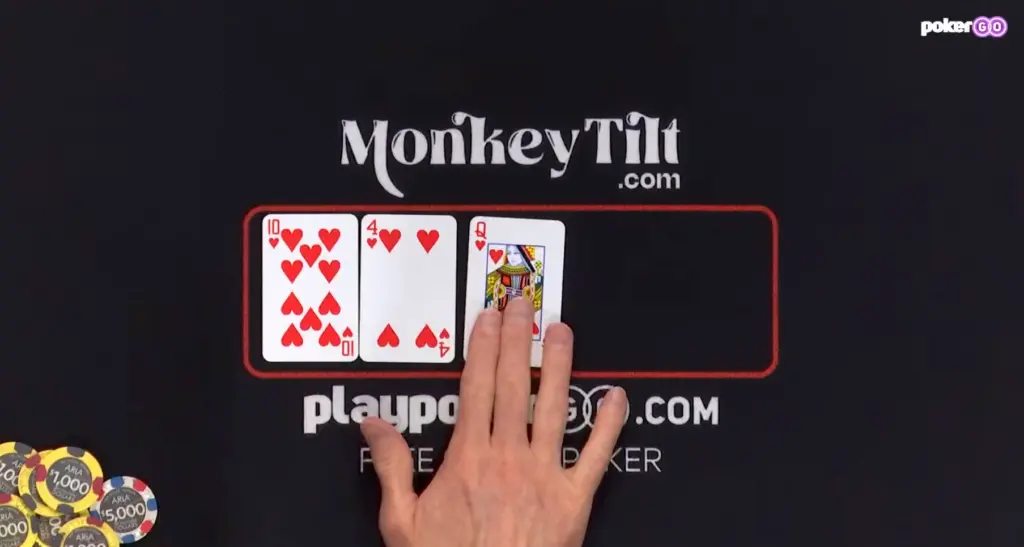
The flop is extraordinarily draw-heavy: three hearts on the board already characterize a potential made flush, alongside quite a few attracts and mixtures. In opposition to 4 gamers, this can be a extremely harmful texture, as ranges are usually considerably stronger in multiway pots.
Alan Keating checks with K4, which is totally commonplace. Whereas he pairs his 4, the hand has little or no worth on such a board, particularly towards a number of opponents.
Senor Tilt continues with a $30,000 wager right into a roughly $60,000 pot. The sizing itself is commonplace, but it surely’s vital to notice that continuation betting on this texture in a multi-way pot is much much less efficient than heads-up. His wager can characterize robust made palms (like a flush), attracts, and even pure bluffs, particularly given his aggressive, high-variance tendencies.
The following participant folds, and Eric Wasserson calls with the nut flush. This is among the most fascinating selections within the hand.
Why not elevate? The slowplay is sensible for a number of causes:
Senor Tilt has a large, aggressive vary and is prone to proceed bluffing
The board is so harmful that worse palms hardly ever proceed versus a elevate
In multiway pots, a elevate usually shuts down the motion instantly
By calling, Wasserson maximizes worth whereas preserving weaker palms and bluffs within the pot. Keating folds, and the hand continues heads-up with a pot of $120,500.
Flip: J – The Important Overbet
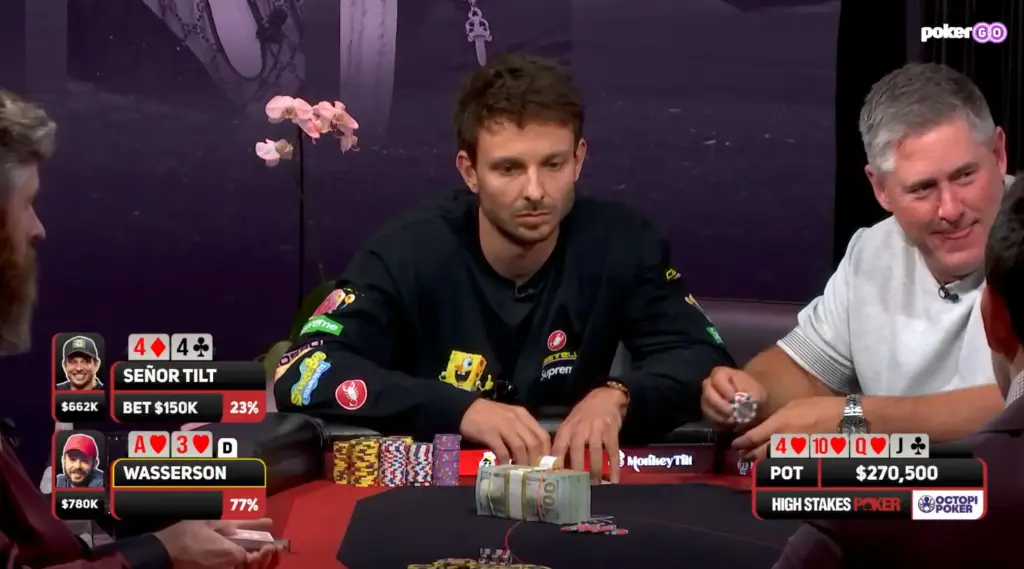
The flip brings the J. Whereas it doesn’t drastically change the board, it does introduce extra straight prospects and will increase the variety of mixtures that may proceed aggressively.
Senor Tilt doesn’t decelerate, he fires a large $150,000 overbet into $120,500.
Executing a correct poker overbet technique in spots like this instantly polarizes a participant’s vary and forces opponents into troublesome selections.
What does this overbet characterize? Sometimes:
very robust palms (flushes, presumably units)
or bluffs attempting to maximise fold fairness
Ranging from a multiway pot makes this much more vital.
What’s the difficulty with this play? There are a number of issues:
The board was already “locked” on the flop with many flushes accessible
Only a few worse palms can name (Qx or Tx wrestle right here)
Higher palms – particularly flushes – virtually at all times proceed
In different phrases, this wager usually retains in precisely the palms that beat you.
What does this say about Senor Tilt poker model? This play completely displays his methodology:
making use of most strain with giant sizing
willingness to construct large pots with marginal or bluff palms
However this strategy can simply flip into spew on textures like this.
Wasserson’s choice. Wasserson as soon as once more simply calls with the nut flush. That is key:
He doesn’t isolate himself towards stronger ranges
He permits additional bluffs
He retains management of the pot
A elevate right here would usually fold out weaker palms and solely get motion from stronger ones. The pot now grows to $420,500, organising a vital river choice. This can be a defining second on this Senor Tilt poker hand, the place aggression begins to work towards him.
Need to analyze spots like this with solver-level precision? Instruments like GTO Wizard might help you break down complicated selections and perceive whether or not an overbet is definitely worthwhile.
Senor Tilt Poker River Resolution: Straightforward Fold or Pricey Name?
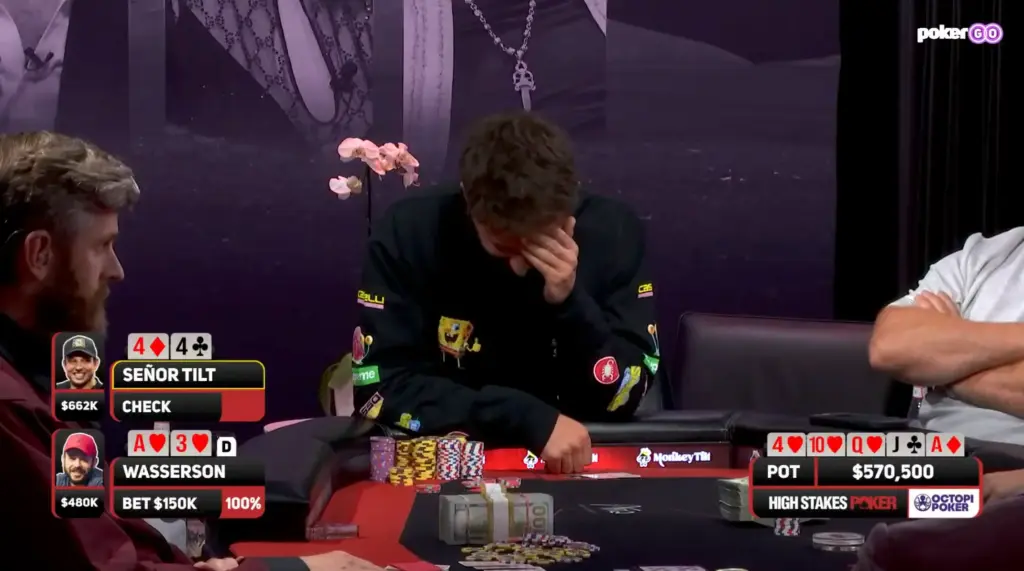
The river is the A , which doesn’t considerably change the dynamic on an already accomplished flush board. Whereas straights at the moment are potential, the core construction of robust palms stays the identical.
Senor Tilt checks, giving up the aggression, and Wasserson makes a comparatively small however very telling $150,000 worth wager into $420,500.
At first look, that is precisely the type of spot we described earlier: a basic “straightforward fold”.
What story does this line inform?
flop: wager → name
flip: overbet → name
river: test → wager
Wasserson performs passively all through, then worth bets on the river – that is fairly often a powerful made hand in stay poker.
What does Senor Tilt beat? That is the important thing query.
missed attracts? → only a few stay
weaker made palms? → hardly ever worth wager
bluffs? → unlikely given the road
There are only a few palms he truly beats.
And what beats him?
all flushes
straights
stronger units
Most significantly: This began as a multiway pot, which considerably will increase the chance of robust palms.
Would you name? For many gamers, this can be a clear fold:
robust flip aggression
passive opponent line
river worth wager
Every thing factors towards folding.
So why does he name? That is the place psychology is available in. Doable causes:
“an excessive amount of cash within the pot” mindset
overvaluing his personal story
overestimating bluffs
pure curiosity from his taking part in model
This choice displays his high-variance strategy – but additionally its draw back. Senor Tilt calls, and Wasserson exhibits the nut flush and wins the $720,000+ pot, whereas Senor Tilt throws his playing cards away in frustration.
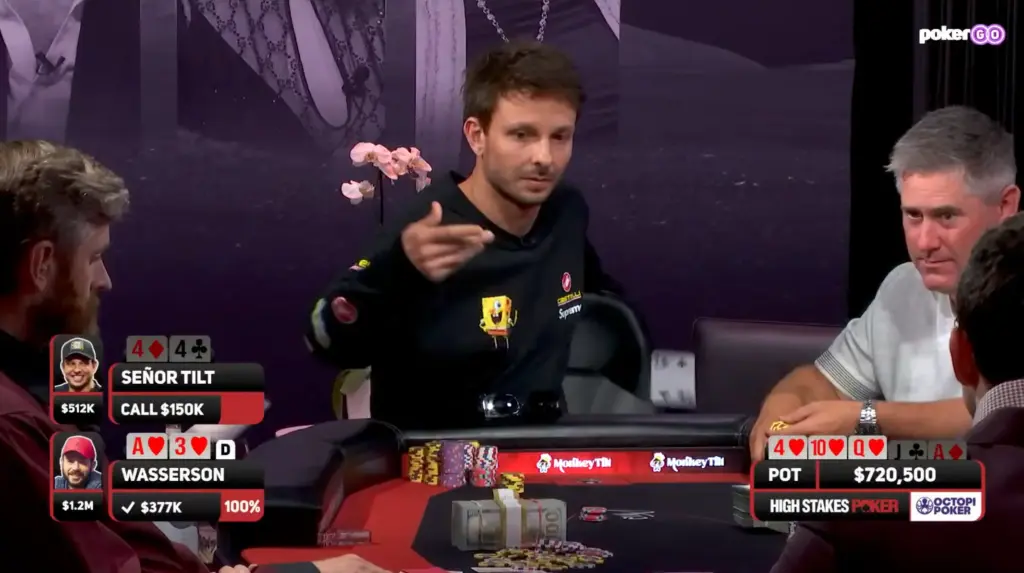
What does the desk discuss reveal?
Some of the fascinating elements of the hand is that Senor Tilt verbalizes his thought course of: “KJ with a J of hearts… KJ with a Ok of hearts…”
At first, this appears logical, but it surely reveals a key mistake: specializing in very particular palms as an alternative of contemplating the whole vary.
In the meantime, Wasserson briefly smiles and covers his mouth – a delicate however basic stay inform of power.
Shortly after, Senor Tilt says the road many gamers acknowledge: “An excessive amount of cash within the pot”.
This mindset usually results in dangerous calls. In actuality, the pot measurement is irrelevant; what issues is whether or not your name is worthwhile.
What can we study from this Senor Tilt Poker Hand?
Multiway pots imply stronger ranges and fewer profitable bluffs
Overbets aren’t efficient on each board, particularly not on accomplished textures
Slowplaying towards aggressive opponents could be extremely worthwhile
River worth bets after passive traces are sometimes very robust
Recognizing “straightforward fold” spots is essential for long-term success
Remaining Ideas
Enjoyable reality, Sam Kiki himself later commented on the hand on PokerGO’s Instagram: “I performed this hand so badly it’s insane”.
That single sentence completely sums up the hand. Even skilled high-stakes gamers make errors, particularly in emotionally charged, high-pressure conditions.
And maybe that’s a very powerful takeaway: It’s not about by no means making errors, however about recognizing them, studying from them, and avoiding them sooner or later.
Often Requested Questions
The put up The $720k Senor Tilt Poker Resolution: Straightforward Fold or Mistake? appeared first on My Poker Teaching.


![[Roblox Undertale: Last Corridor] The clock hits zero, CASINO UPDATE!!!](https://i0.wp.com/i.ytimg.com/vi/O5o8wprsiiA/hqdefault.jpg?resize=120%2C86&ssl=1 "[Roblox Undertale: Last Corridor] The clock hits zero, CASINO UPDATE!!!")


